
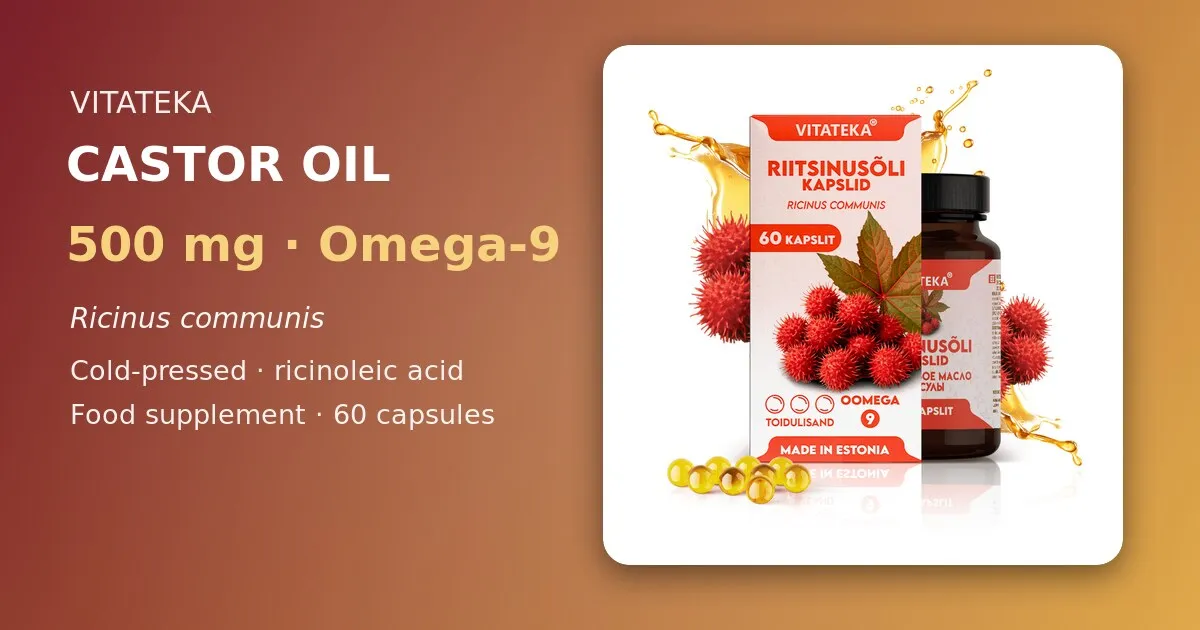
VITATEKA Castor Oil capsules (Ricinus communis) are a food supplement in capsule form. Castor oil is one of the best-known vegetable oils, familiar across many traditions. In terms of composition it is a source of monounsaturated omega-9 fatty acids, and its characteristic component is ricinoleic acid, which makes up about 87%.
In this article we look at the composition, what omega-9 and ricinoleic acid are, how to take the supplement, and what to keep in mind.
Composition: a cold-pressed oil
The formula is concise. The base is cold-pressed castor oil, and the antioxidant is a tocopherol extract (which helps protect the oil from oxidation). The capsule shell is bovine gelatin, and the humectant is glycerol and water. One capsule contains 500 mg of oil; there are 60 capsules per pack.
What omega-9 and ricinoleic acid are
Omega-9 are monounsaturated fatty acids; unlike omega-3 and omega-6, the body can synthesise them on its own. Ricinoleic acid is the characteristic fatty acid of castor oil: it makes up the main part of the oil (about 87%) and is rarely found in such an amount, which is what makes castor oil recognisable by its composition. Fatty acids are a natural part of a balanced diet.
Why people choose castor oil capsules
Castor oil is a traditionally known and recognisable product. In capsule form it is convenient to take: there is no liquid to measure and no characteristic taste and smell of castor oil to put up with. If vegetable oils in general interest you, take a look at the edible oils section.
Format: 500 mg capsules
The 500 mg capsules are convenient to dose. There are 60 capsules per pack. The capsule protects the oil from light and air, and the tocopherol antioxidant helps preserve its properties.
How to take
The recommended daily amount for adults is 1–3 capsules a day, ideally with a meal. Do not exceed the recommended daily dose. A food supplement is not a substitute for a varied and balanced diet and a healthy lifestyle.
Precautions
- do not use in case of individual intolerance to the ingredients;
- do not exceed the recommended daily dose;
- during pregnancy and breastfeeding, consult a doctor;
- it is not a medicine and does not replace a complete and balanced diet;
- store in a dry place, protected from light, at a temperature up to +25 °C and out of the reach of children.
Who it suits
- Those who want to add a source of omega-9 to their diet — monounsaturated fatty acids;
- Those interested in castor oil — a recognisable oil with its characteristic ricinoleic acid;
- Those who value convenience — capsules with no oil taste or smell, and a 60-capsule pack.
Castor oil in cosmetics
Castor oil is also widely known in external cosmetic care — for hair, eyelashes and eyebrows. This is a separate, external way of using it, unrelated to taking the capsules internally. If the cosmetic format is what interests you, the VITATEKA range includes liquid castor oil for external use: castor oil 25 ml and castor oil 100 ml, as well as the hair oils section.
Related products
To vary the fatty acids in your diet, it makes sense to pair omega-9 with omega-3 — for example, omega-3 capsules. The VITATEKA range also includes other vegetable oils in capsules: black cumin oil and evening primrose oil. Useful catalogue sections:
More to read on the blog
Take a look at other materials about vegetable oils in capsules: about black cumin oil, about evening primrose oil, about sea buckthorn oil and about milk thistle oil.
Where to buy
Product page: VITATEKA Castor Oil capsules 500 mg, 60 capsules.
A food supplement. It is not a medicine. Do not exceed the recommended daily dose. Before use, especially during pregnancy and breastfeeding, consult a specialist. Keep out of the reach of children.